
Best Borosilicate Glass Teapots for Blooming Tea (Heat-Resistant Picks)
Compare the best borosilicate glass teapots for blooming tea and loose-leaf infusions—covering thermal shock safety, optical clarity, and spout cut-off.
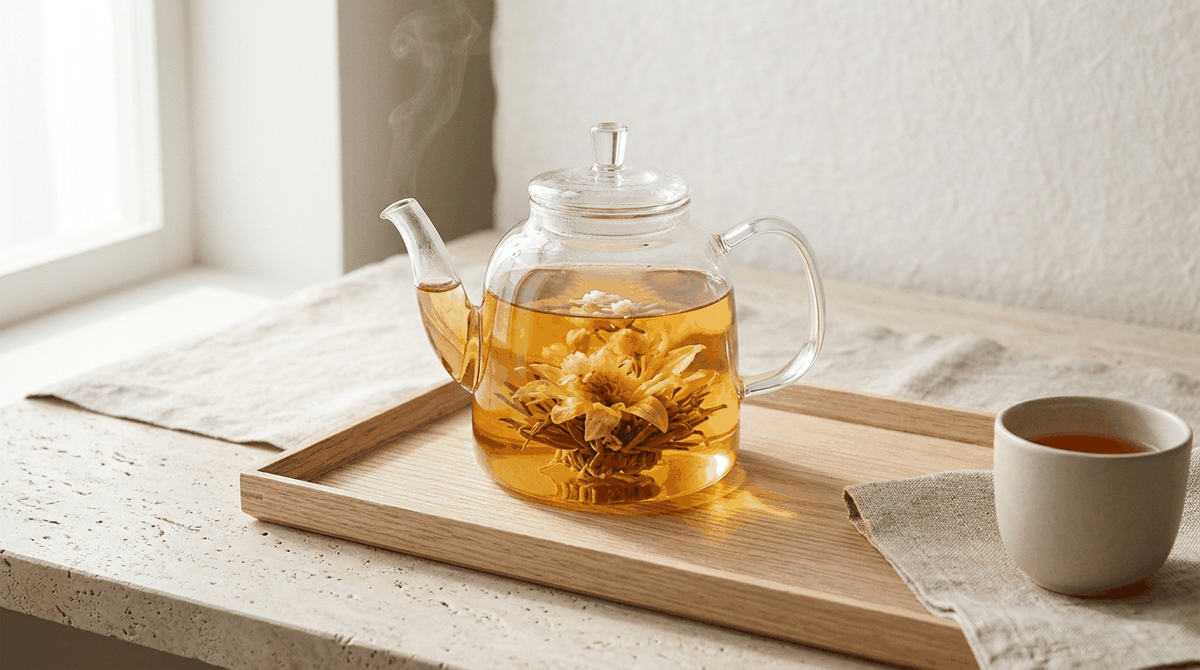
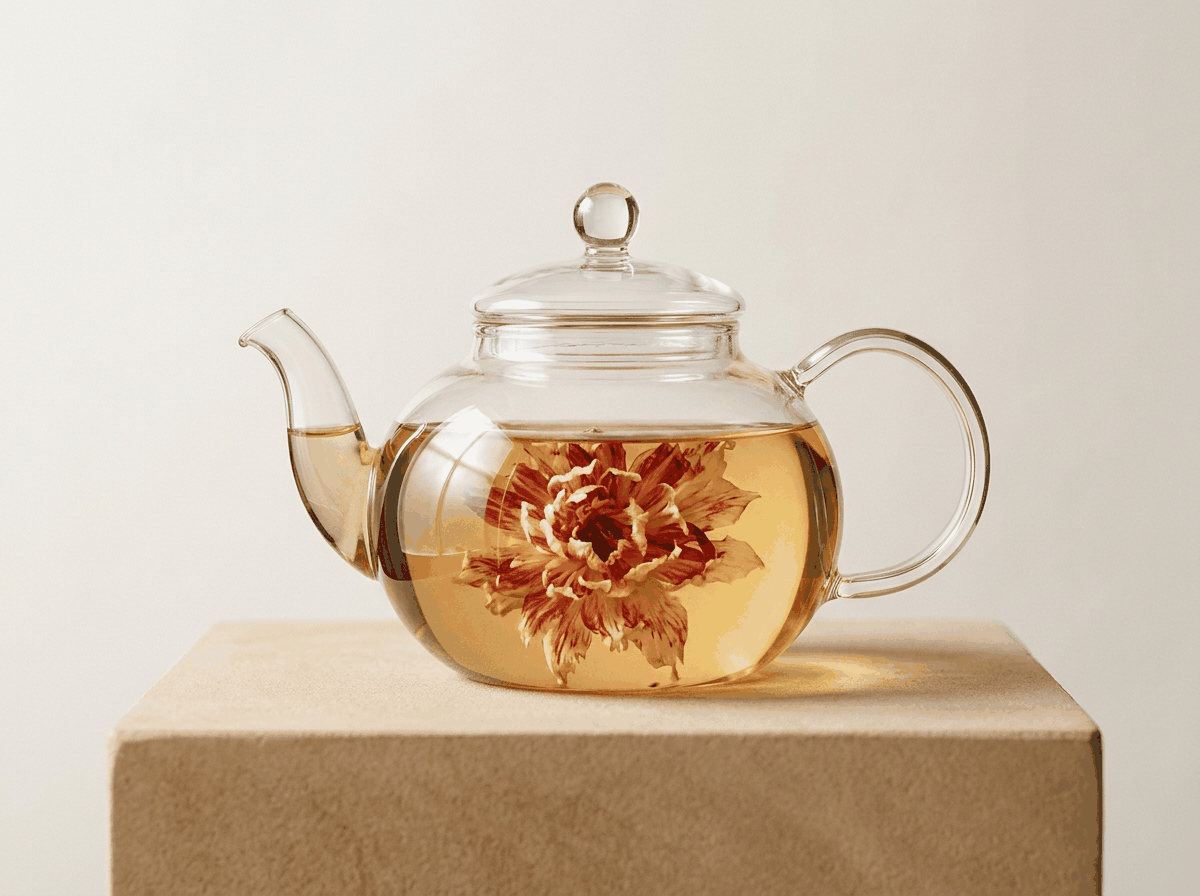
Teabloom Celebration Borosilicate Flowering Teapot
Best for:Blooming tea displays, tabletop candle warmers, and gentle stovetop use
Borosilicate Glass · 1,200 ml (40 oz)
- Extra-wide crystal belly frames full jasmine and lily blossoms without optical distortion
- Stovetop-rated borosilicate body handles low gas flame and radiant electric coils safely
- Removable glass spiral infuser doubles cleanly for loose-leaf infusions
A transparent glass teapot turns brewing from blind guesswork into observable physics. You see tiny convection plumes carry silver tea needles upward toward the water surface, watch emerald green liquor darken from pale chartreuse to amber, and—when steeping hand-sewn flower blossoms—witness a tight pearl of silver needle tea unfold into a bright marigold or lily dome right at the table.
Yet glass is also unforgiving of poor engineering. Cheap novelty vessels blown from thin soda-lime glass crack at the spout join the first time winter tap water meets a kettle boil, while awkwardly shaped spouts drool golden tea onto linen napkins.
Choosing the best borosilicate glass teapot means evaluating thermal expansion engineering, optical lens geometry, spout lip beveling, and infuser depth side by side. Below, I break down how lab-grade borosilicate works under heat, when stovetop brewing is actually safe, and which vessels passed our pour-mechanics bench test.
Borosilicate 3.3 vs. Soda-Lime Glass: Why Chemistry Dictates Safety
Not all clear glass behaves the same way when you pour 208°F (98°C) water into a chilled vessel at room temperature. Standard household tumblers and decorative pitchers are typically molded from soda-lime glass, which carries a high coefficient of thermal expansion (roughly 9 × 10⁻⁶ /K). When boiling water heats the inner wall faster than heat conducts to the outer face, internal tensile stress builds rapidly—and the vessel snaps along the weakest seam, usually where the handle or spout meets the belly.
A true borosilicate glass teapot uses silica infused with roughly 12% to 15% boron trioxide. That formulation slashes thermal expansion down to roughly 3.3 × 10⁻⁶ /K—meaning the glass wall barely shifts dimensionally across a 300°F (150°C) temperature swing.
Even within authentic borosilicate teapots, build thickness and flameworking matter enormously:
- Uniform Wall Distribution: Hand-blown flowering teapot bodies should maintain consistent 2.5mm to 3.5mm wall thickness across the lower curve and base. Paper-thin blown ornaments cool faster and shatter easily against sink edges.
- Annealed Spout & Handle Joins: Look closely at where the spout root attaches to the round chamber. Smooth, rounded glass fillets indicate proper kiln annealing to relieve internal stress, whereas sharp creases trap tension.
- Optical Clarity Without Ripples: Look straight through the center belly toward text on paper. High-grade borosilicate exhibits crisp refraction with minimal wave distortion, ensuring blooming tea bulbs remain sharp and jewel-like from every seat at the table.
Can You Put a Glass Teapot on a Stove? (Thermal Rules Explained)
One of the top questions readers ask us is “can you put glass teapot on stove” burners—and the short answer is only when both the glass specification and heat source align.
Many everyday glass tea servers, including the Hario ChaCha Kyusu Maru 700ml, are engineered strictly as infusion vessels designed to receive pre-boiled water from a dedicated kettle. Placing a standard pouring vessel directly onto a blazing stove coil concentrates radiant heat onto a tiny ring, starving the side walls of uniform expansion and risking catastrophic failure.
Even when using an explicitly stovetop-rated borosilicate glass teapot such as the Teabloom Celebration Borosilicate Flowering Teapot, follow five non-negotiable stovetop safety rules:
- Always Fill Water Before Ignition: Never pre-heat an empty glass teapot on a burner. Fill the chamber at least one-third full with room-temperature or warm water before turning on heat.
- Respect Stove Type Differences:
- Gas Ranges: Keep the flame low and strictly smaller than the flat base footprint. Use a metal heat-diffuser trivet whenever possible so flame tongues never lick the curved glass sidewall or handle root.
- Radiant Electric & Glass Ceramic Tops: Use low to medium heat only. Exposed glowing coil burners deliver intense pinpoint heat—keep contact brief and lift by a dry potholder if needed.
- Induction Cooktops: Glass is non-magnetic and will never heat on an induction stove unless the pot sits atop a ferromagnetic stainless induction diffuser disk.
- Avoid Rapid Thermal Reversal: Never lift a hot stovetop glass pot directly off a burner and set it onto cold marble, wet granite, or ice. Rest it on a cork trivet, bamboo mat, or wooden tray.
- Watch the Spout Water Level: Boiling creates vigorous convection bubbles. Fill only to the maximum recommended shoulder line so boiling surges do not blast scalding liquid out the spout.
- Prefer Candle Tea-Light Warmers for Serving: Once your tea reaches infusion temperature, moving the vessel onto a vented glass or ceramic tea-light warmer preserves gentle drinking warmth without re-boiling delicate leaves into bitterness.
Blooming Tea Vessel Geometry: Why Belly Shape Changes Everything
A dedicated blooming tea teapot has very different spatial requirements from an everyday loose leaf teapot. A single hand-tied tea blossom typically measures 25mm dry, yet unfurls vertically into an 80mm to 100mm floral arch crowned with globe amaranth, jasmine strands, or calendula petals.
If you drop a flowering tea bulb into a narrow 600ml glass carafe or leave a metal infuser basket hanging inside the lid, two things go wrong immediately: the compressed petals fold awkwardly against the sidewalls, and stagnant water beneath the lid fails to circulate cleanly around the core leaves.
When shopping specifically for a flowering teapot, check three spatial benchmarks:
- Internal Belly Diameter (115mm+): A broad, low-slung sphere or flattened dome creates natural lateral stage room without magnifying lens distortion.
- Vertical Headroom (95mm–120mm): Tall blossoms need room to stretch cleanly beneath the lid collar without brushing against glass stops.
- Removable Infuser Hardware: Choose a model where the glass or metal infuser lifts out entirely, leaving a completely unobstructed optical chamber for blooming bulbs—then snaps right back in when you switch to daily loose-leaf jasmine or oolong.
Top Lab-Tested Borosilicate Glass Teapot Reviews
1. Teabloom Celebration Borosilicate Flowering Teapot (Best Flowering & Stovetop Pick)
If your primary passion is theatrical blooming tea displays alongside large-batch herbal or white tea service, the Teabloom Celebration Borosilicate Flowering Teapot hits the sweet spot between optical clarity and practical daily engineering.
Its 1200ml (40 oz) crystal-clear chamber easily clears the 115mm lateral room benchmark so jasmine and lily flowers expand upright in full symmetry. Unlike delicate thin-walled imports that feel nervous over heat, Teabloom crafts this vessel from thick, lab-grade borosilicate rated for gentle stovetop use on low gas or electric burners, as well as microwave warming and dishwasher cleanup.
On our pour bench, the sculpted spout delivered a confident 9/10 laminar cut-off when held at a 50-degree tilt, leaving zero runback along the underside edge—though its generous all-glass lid warrants resting a steady thumb against the finial near the end of a full pot. It also includes a loose-leaf glass infuser insert, keeping metallic interference away from delicate floral teas.
- Best For: Blooming tea displays, tabletop candle warmers, and flexible 4-to-5 cup hosting (
$$tier). - Pour Score: 9 / 10 | Heat Score: 6.5 / 10
2. Hario ChaCha Kyusu Maru 700ml (Best Everyday Loose-Leaf Glass)
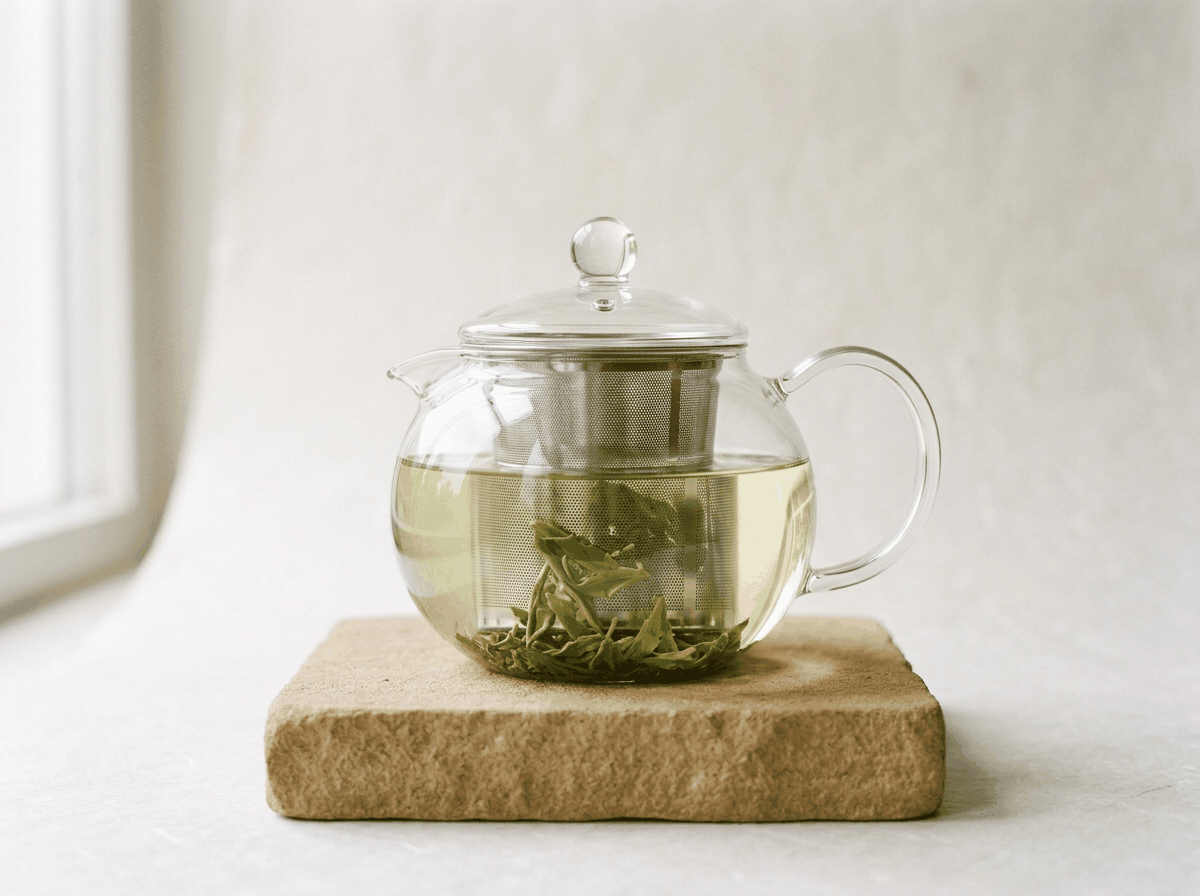
When your goal shifts from floral showpieces to high-precision daily loose-leaf steeping, nothing touches the utilitarian grace of the Japanese-engineered Hario ChaCha Kyusu Maru 700ml.
Hario replaces cramped floating metal balls with a sweeping, ultra-deep stainless steel mesh basket that extends nearly to the rounded floor of the pot. Even if you steep just 250ml of water for a quiet solo mug, the tea leaves remain fully submerged with generous expansion space—essential for rolled Taiwanese high-mountain oolongs.
Wait until you lift the pouring handle: Hario’s stubby, crisp-edged glass spout terminates with a sharp 9/10 snap cut-off that puts many boutique ceramic pots to shame. Note that the ChaCha Kyusu Maru is strictly a countertop steeping vessel rather than a stovetop kettle; boil water separately and consult our Tea Steeping Timer Tool so green and white leaves stay sweet.
- Best For: Daily loose-leaf visibility, half-pot solo steeps, and entry-tier reliability (
$tier). - Pour Score: 9 / 10 | Heat Score: 6 / 10
3. Magnetic Semi-Automatic Glass Gongfu Teapot (Best Precision Steep Control)
For drinkers who crave the visual theater of a glass teapot without hovering over a stopwatch to avoid over-extraction, the Magnetic Semi-Automatic Glass Gongfu Teapot adds kinetic precision to the table.
Steeping happens inside an elevated borosilicate cylinder locked onto an angled wooden or bamboo stand. When your infusion reaches peak sweetness, nudging the stand arm aligns a concealed magnet with a stainless ball bearing valve—draining amber oolong into the clear 500ml lower server in roughly four seconds while leaving every leaf behind dry and ready for a second flash steep.
- Best For: Multi-infusion oolongs, desk brewing, and zero-oversteep precision (
$$tier). - Pour Score: 9.5 / 10 | Heat Score: 7 / 10
Glass Teapot Infuser Comparison: Which Filter Preserves Flavor?
| Infuser Type | Best Tea Styles | Flavor Purity | Clean-Up Effort | Typical Pour Behavior |
|---|---|---|---|---|
| Deep Stainless Steel Basket | Rolled oolongs, sencha, black teas, herbs | Very High (food-grade 304 steel) | Rinse & tap out in seconds | Unobstructed full-spout laminar stream |
| All-Glass Slotted Cylinder | Large white peony, coarse oolong, herbal blooms | Maximum (zero metal contact) | Dishwasher safe; narrow slots need brush | Crisp flow, though fine dust can escape |
| Removable Glass Spout Spiral | Blooming tea bulbs, very large whole leaves | Maximum (open belly circulation) | Rinses instantly under faucet | May slow slightly if thick flower stems shift |
| Magnetic Ball-Valve Chamber | Gongfu oolongs, pu-erh, repeatable short steeps | High (instant drain separation) | Rinse upper glass cup & steel valve | Cleanest separation of leaf and liquor |
Keeping Crystal Clear: Heat Retention & Care Tips
Single-wall borosilicate glass naturally sheds heat faster than thick stoneware or cast iron—earning lower thermal scores (6 to 7 out of 10) in thirty-minute cooling benchmarks. That makes glass a natural match for green teas, white teas, and blooming tea blends steeped between 175°F and 195°F (80°C–90°C), which thrive as water gently cools instead of stewing at a boil.
If you plan to brew hearty black teas or host long weekend conversations around a 1200ml flowering teapot, pair your vessel with a ventilated glass tea-light warmer or review insulated options in our 25 Coolest & Most Unique Teapots Pillar Guide. For an honest material-by-material breakdown comparing glass against Tokoname clay and cast iron, check our Teapot Materials Comparison.
Finally, never let mineral rings or tannin haze dull your view. A quick weekly soak using sodium percarbonate or gentle baking soda paste—detailed step by step in our Complete Teapot Care & Descaling Guide—keeps every borosilicate curve gleaming like optical crystal. Ready to compare ceramic side-handle ergonomics next? Explore our Authentic Japanese Kyusu Teapots Guide.
Hands-On Benchmarks
Tested Picks & Recommendations
Teabloom Celebration Borosilicate Flowering Teapot
Borosilicate Glass · 1,200 ml (40 oz)
Best ForBlooming tea displays, tabletop candle warmers, and gentle stovetop use
What We Loved
- Extra-wide crystal belly frames full jasmine and lily blossoms without optical distortion
- Stovetop-rated borosilicate body handles low gas flame and radiant electric coils safely
- Removable glass spiral infuser doubles cleanly for loose-leaf infusions
Trade-offs
- Glass lid requires a steady thumb rest during steep-angle pours
- Large 1200ml chamber loses heat noticeably without a tea-light warmer base
Hario ChaCha Kyusu Maru 700ml
Borosilicate Glass · 700 ml (23.7 oz)
Best ForDaily loose-leaf clarity, green teas, and budget-friendly durability
What We Loved
- Deep full-height stainless steel mesh basket hydrates leaves even in half-full pots
- Precision-beveled glass spout lip produces a crisp, drip-free stream stop
- Lightweight Japanese borosilicate resists mineral clouding and cleans effortlessly
Trade-offs
- Not built for direct stovetop burner or flame contact
- Single-wall glass cools faster than stoneware for high-heat black teas
Frequently Asked Questions
What makes a borosilicate glass teapot safer than standard soda-lime glass?
Borosilicate 3.3 glass incorporates boron trioxide into the silica matrix, lowering its coefficient of thermal expansion to roughly one-third that of standard soda-lime glass. Because the material barely expands or contracts when hit by boiling water, it resists thermal shock fractures far more reliably.
Can you put a glass teapot on an electric or gas stove safely?
Only if the manufacturer explicitly rates the vessel for stovetop heat and you follow strict thermal precautions: never place an empty glass pot over heat, keep gas flames smaller than the base diameter (or use a wire diffuser), use low-to-medium radiant electric settings, and note that glass never works on induction burners without a ferromagnetic steel adapter plate.
What size flowering teapot works best for blooming tea bulbs?
Look for a vessel holding at least 800ml to 1200ml with an internal belly width of 110mm to 135mm and vertical clearance of at least 95mm. Smaller teapots crush the tall jasmine or globe amaranth arch mid-bloom, while narrow pitchers restrict lateral petal expansion.
Glass spiral filter vs. stainless mesh basket: which should I choose?
A glass spiral or slotted glass cylinder works best if you brew only large whole-leaf teas and want zero metallic contact, though fine broken leaves can slip past glass slits. A deep fine-mesh stainless steel basket is far more versatile across broken green teas, herbal blends, and blooming teas.
How do I remove tea stains and hard-water cloudiness from a glass teapot?
For brown tannin film, soak the interior with warm water and one teaspoon of baking soda or sodium percarbonate for 20 minutes, then swirl gently with a soft sponge. For chalky white limescale rings left by hard water, rinse with a warm 1:4 white vinegar or citric acid solution and flush thoroughly.
Curated Picks
Related Guides in This Cluster
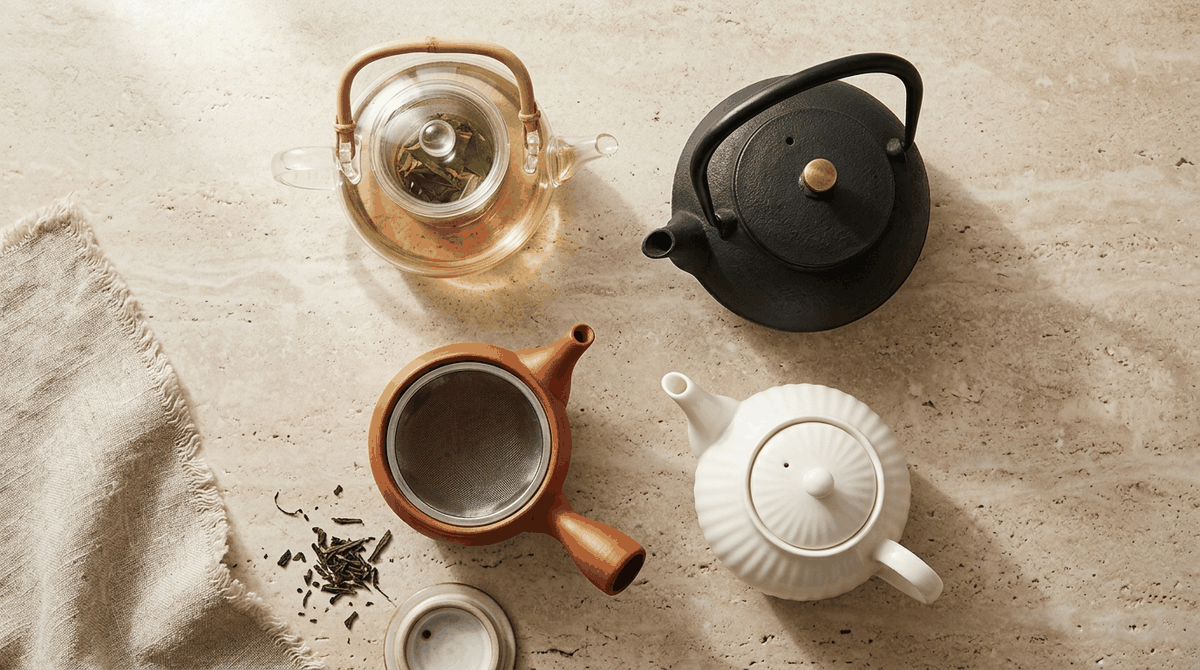
25 Coolest & Most Unique Teapots That Actually Pour Well
Our lab-tested guide to the 25 coolest and most unique teapots—combining sculptural glass, Japanese kyusu, and cast iron with laminar non-drip pouring.
Best Japanese Cast Iron Teapots (Tetsubin) That Won't Rust
Hands-on comparison of the best Nanbu Tekki cast iron tetsubin and enamel-lined iron teapots—covering internal rust prevention, heat inertia, and safe daily use.
Authentic Japanese Kyusu Teapots: Side-Handle vs. Back-Handle Picks
Master the craft of authentic Japanese kyusu teapots: yokode side-handle ergonomics, Tokoname clay mineral physics, and sasame ceramic mesh vs. steel strainers.